
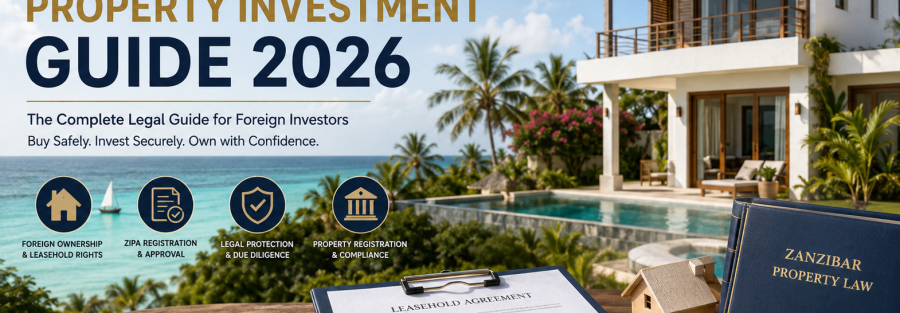
Zanzibar has rapidly positioned itself as one of Africa’s most attractive luxury property and residential investment destinations, drawing international buyers seeking beachfront villas, branded residences, private apartments, resort developments, and long-term investment assets along the Indian Ocean coastline. Investors from Europe, the Gulf region, Asia, and Africa continue to enter the Zanzibar market due to rising tourism demand, expanding infrastructure, and growing international visibility. However, many foreign buyers incorrectly assume that purchasing property in Zanzibar follows the same legal framework used in Dubai, Europe, or mainland Tanzania. It does not. Zanzibar operates under a unique land and investment structure where foreign ownership rights are carefully regulated through leasehold systems, investment approvals, and government-controlled land administration. Understanding these legal realities before committing capital is what separates secure investment from high-risk exposure.
- The Core Legal Principle: Foreigners Cannot Own Freehold Land in Zanzibar
The most important rule governing real estate acquisition in Zanzibar is straightforward:
Foreign nationals cannot own freehold land in Zanzibar.
All land within Zanzibar is legally vested in the Revolutionary Government of Zanzibar. This principle forms the foundation of Zanzibar’s property system and directly affects every foreign property transaction.
What international buyers can legally acquire is a long-term leasehold interest, commonly structured through:
- Granted Rights of Occupancy (GRO)
- Long-term lease agreements
- Derivative rights or subleases
- Developer-issued leasehold interests
When properly registered and legally secured, these rights provide strong commercial value and long-term security. In practical investment terms, they allow foreign buyers to:
- Occupy and use the property
- Sell the leasehold interest
- Transfer inheritance rights
- Mortgage the property interest
- Generate rental income
- Operate the property as an investment asset
The critical issue is not whether the property is called “leasehold” or “freehold.” The real issue is whether the legal interest being acquired is valid, registered, enforceable, and properly structured.
- Legal Structures Available for Foreign Property Buyers
- Direct Long-Term Leasehold Acquisition
Foreign investors may acquire long-term lease rights over developed residential property, usually ranging from 33 to 99 years depending on the transaction structure and project approvals.
In many modern apartment and villa developments, the buyer acquires a leasehold interest in an individual residential unit while the developer retains the primary land interest.
This model is widely used in integrated residential projects and investment zones across Zanzibar.
- Property Acquisition Through a Zanzibar Company
Another commonly used structure involves incorporating a local Zanzibar company to hold the property interest.
Under this arrangement:
- The company becomes the registered holder of the land interest
- The investor owns shares in the company rather than holding the lease personally
This structure is frequently used for:
- High-value real estate acquisitions
- Estate planning strategies
- Joint investments
- Property portfolio management
- Financing and mortgage structuring
However, this model also introduces ongoing corporate compliance obligations that buyers must fully understand before proceeding.
- Developer Leasehold Projects
Many foreign investors purchase apartments, resort residences, or villas within large-scale developments where the developer grants sublease rights to buyers.
This has become one of Zanzibar’s fastest-growing real estate investment models.
However, not all development projects offer equal legal protection.
Critical Legal Risk for Buyers
One of the biggest mistakes foreign investors make is relying solely on developer marketing materials without independently verifying:
- The developer’s land title
- Existing encumbrances
- Government approvals
- Land registration status
- Sublease conditions
- Service charge obligations
- Project financing stability
Several buyers in Zanzibar have encountered projects where:
- The developer’s title was incomplete
- Land disputes existed
- Government approvals were unresolved
- Sublease terms heavily favored the developer
- Registration processes were delayed
Independent legal due diligence is not optional in Zanzibar property transactions. It is one of the most important investment protection tools available to a foreign buyer.
III. ZIPA Registration Requirements for Foreign Investors
Foreign property buyers exceeding prescribed investment thresholds are generally required to register through:
Zanzibar Investment Promotion Authority
ZIPA registration plays a major role in foreign investment protection because it provides:
- Official recognition of the investment
- Government investment protection guarantees
- Capital repatriation protections
- Regulatory approval support
- Access to investment incentives in qualifying projects
Without ZIPA approval, foreign buyers may encounter serious difficulties during property registration and government consent procedures.
Minimum Investment Thresholds
ZIPA periodically establishes minimum qualifying investment thresholds for foreign investors.
These thresholds may vary depending on:
- Property category
- Development structure
- Investment sector
- Project scale
Buyers should never rely on outdated threshold figures from developers, agents, or online marketing content without independent verification.
- The Zanzibar Property Conveyancing Process
- Reservation Agreements and Initial Commitments
Most property transactions begin with:
- Reservation agreements
- Heads of terms
- Initial deposits
Foreign buyers often underestimate the legal consequences of these documents.
Some reservation agreements contain:
- Non-refundable deposit clauses
- Penalty provisions
- Strict completion obligations
Even supposedly “informal” reservation documents can create significant financial exposure.
- Legal Due Diligence
A proper Zanzibar property investigation should cover three essential areas:
Title Due Diligence
This verifies:
- Ownership legitimacy
- Land registry status
- Existing disputes
- Encumbrances
- Court restrictions
- Competing claims
Regulatory Due Diligence
This confirms:
- ZIPA compliance
- Planning approvals
- Development permits
- Land use compliance
Contractual Due Diligence
This examines:
- Sale agreements
- Lease terms
- Developer obligations
- Completion timelines
- Default remedies
- Service charge structures
Weak due diligence is one of the primary causes of failed foreign property investments in Zanzibar.
- Government Consent and Property Registration
After signing the transaction documents and completing payment obligations, the buyer’s leasehold interest must be approved and registered through the relevant Zanzibar land authorities.
Registration is the legal mechanism that protects ownership rights against third parties.
An unregistered property interest — even where the buyer has paid the full purchase price — creates substantial legal vulnerability.
Major Registration Risk
A significant number of foreign buyers in Zanzibar have:
- Paid in full
- Taken possession of units
- Received keys
- Occupied the property
…without completing official registration of their legal interest.
This creates a dangerous situation where the buyer may hold only a contractual claim rather than a fully registered legal interest.
If the developer later becomes insolvent, enters dispute, or transfers competing interests, resolving the issue can become extremely difficult and financially damaging.
- Property Taxes and Transaction Costs
Foreign investors should budget beyond the purchase price itself.
Common acquisition costs may include:
- Stamp duty
- Land registration fees
- Government consent charges
- ZIPA registration fees
- Legal fees
- Annual ground rent
- Service charges
- Property management fees
For managed developments, recurring maintenance and operational charges can become substantial over time and should be reviewed carefully before purchase.
VII. Off-Plan Property Purchases in Zanzibar
Off-plan developments have become increasingly common across Zanzibar’s residential market.
These investments may provide:
- Lower entry pricing
- Capital appreciation potential
- Flexible payment structures
However, they also create construction and delivery risks.
Essential Protections for Off-Plan Buyers
Strong legal agreements should include:
- Stage-based payment structures
- Construction milestone protections
- Completion deadlines
- Buyer termination rights
- Refund protections
- Developer warranties
- Insolvency safeguards
Developers unwilling to provide meaningful contractual protection should be approached with caution.
VIII. Mortgage Financing for Foreign Buyers
Mortgage financing options for foreign nationals in Zanzibar remain limited but are gradually expanding.
Some local banks may offer financing subject to:
- Lower loan-to-value ratios
- Higher interest rates
- Strict income verification
- Immigration and residency requirements
Because Zanzibar property operates under a leasehold framework, mortgage structuring requires careful legal coordination.
Most foreign investors currently finance purchases through:
- Cash acquisitions
- Overseas financing
- Asset-backed lending from their home jurisdictions
Conclusion
Zanzibar continues to attract global real estate investors seeking beachfront living, luxury residences, tourism-linked assets, and long-term capital appreciation within one of Africa’s fastest-growing coastal investment markets. But successful property acquisition in Zanzibar is not driven by marketing brochures, developer promises, or speculation. It is driven by legal structure, regulatory compliance, proper due diligence, and disciplined transaction management. Foreign buyers who secure independent legal representation, verify land rights thoroughly, complete ZIPA and registration procedures correctly, and insist on enforceable contractual protections position themselves to benefit from Zanzibar’s expanding property market with significantly reduced legal and financial risk. Those who ignore the legal framework, rely entirely on developer-controlled processes, or fail to register their interests properly often discover problems only after substantial capital has already been committed. In Zanzibar’s rapidly evolving real estate sector, the difference between a secure investment and a costly mistake is almost always determined before the purchase is completed.
Looking forward to investing in Zanzibar?
Reach out directly to our esteemed team at (info@gerpatsolutions.co.tz) www.gerpatsolutions.co.tz |+255742816955